
MICCAI 2025 Lighthouse Challenge – BraTS Inpainting
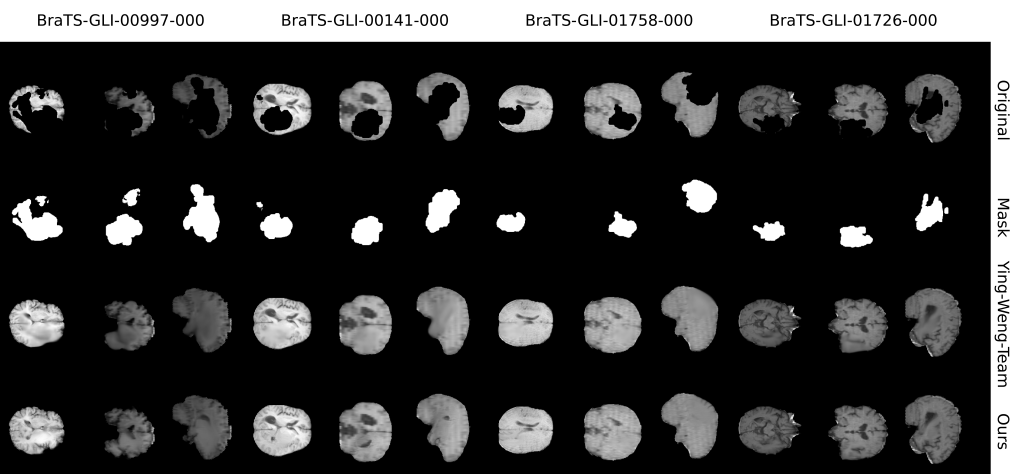
Reconstructing how a patient’s brain might have looked without a tumor is a visual challenge. MRI scans altered by tumors disrupt downstream tasks such as registration, longitudinal tracking, morphometric analysis, and surgical or radiotherapy planning, all of which assume an anatomically complete and undistorted brain. The goal of brain tumor inpainting is therefore not to fill in missing pixels, but to restore plausible neuroanatomy in 3D (including consistent tissue boundaries, structural continuity, and biologically valid morphology). Achieving this demands synthesis that is not only realistic in appearance, but structurally faithful at the tissue level, especially when large regions are missing or distorted.
Toward structure-aware medical image synthesis
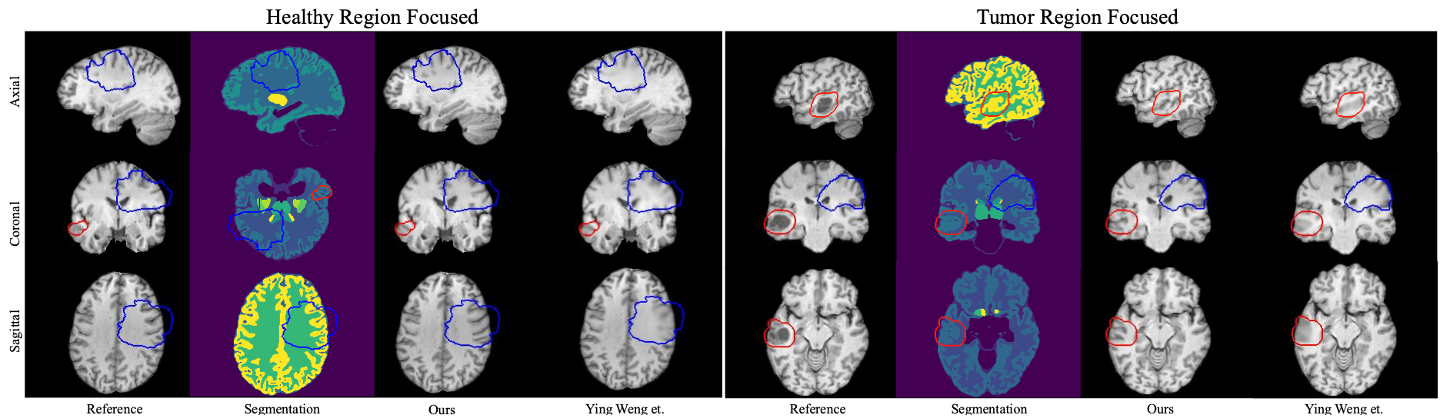
For the BraTS 2025 Inpainting Challenge, we developed PSegGAN (Pseudo-Segmentation-Guided GAN), a 3D inpainting framework that integrated anatomical priors directly into the generative process rather than treating inpainting as a generic pixel completion task. We guided reconstruction using pseudo-segmentation signals to enforce tissue-level consistency and structural continuity, enabling the model to recover plausible neuroanatomy beyond surface-level realism. This approach achieved 🥈 2nd place globally, demonstrating high-fidelity reconstruction with strong anatomical validity under large missing-region scenarios.
Explore More Works and Projects!
 JIYEONG OH