


MPCC Control with Bounded Rational Decision-Making
Autonomous racing is not just about following a track as fast as possible. In real racing scenarios, an autonomous vehicle must operate in a dynamic, multi-agent environment, where other vehicles behave unpredictably, make suboptimal decisions, and continuously change their strategies. Overtaking, in particular, requires balancing aggressive progress, collision avoidance, and real-time decision-making under uncertainty.
Many autonomous driving controllers excel at stable trajectory tracking, but struggle in racing contexts where strict time-indexed references break down. When a vehicle falls behind a predefined trajectory, traditional MPC often reacts by aggressively “catching up,” leading to instability, especially in close-proximity, multi-vehicle interactions. At the same time, most opponent modeling approaches assume perfectly rational agents that always maximize a known utility, which rarely holds in high-speed racing where computational and time constraints dominate behavior.
This project was motivated by a simple question:
How can an autonomous vehicle overtake safely and competitively when other agents behave imperfectly and unpredictably?
From trajectory tracking to progress-aware control
To address the limitations of time-based MPC, we adopted Model Predictive Contouring Control (MPCC) as the foundation of our control framework. Rather than tracking a fixed trajectory over time, MPCC operates in the spatial domain, explicitly optimizing geometric path accuracy and forward progress along the track.
By introducing a progress variable along the reference path, MPCC allows the vehicle to dynamically adjust its speed and racing line based on curvature, interactions, and constraints, without being forced to match a predefined timing profile. This makes it particularly well-suited for racing scenarios that require flexible cornering, adaptive speed control, and real-time reactions to nearby vehicles.
We implemented the MPCC controller using ROS2 and CasADi, enabling real-time optimization under vehicle dynamics and actuator constraints. Collision avoidance was integrated directly into the optimization objective using soft constraints, allowing the vehicle to maintain safety margins around obstacles and other vehicles while preserving feasibility in dense racing scenarios.
Modeling opponents as boundedly rational agents
Control alone is not sufficient for safe and competitive overtaking. The ego vehicle must also anticipate how opponents are likely to behave, not how they should behave under idealized assumptions.
We modeled opponent behavior using information-theoretic bounded rationality, which captures decision-making under limited information, time, and computational resources. Instead of assuming that agents strictly optimize a known utility function, this framework represents behavior as a probabilistic trade-off between utility maximization and decision complexity.
Opponent trajectories were generated through controlled sampling and weighted based on estimated rationality parameters, producing behavior predictions that reflect realistic, “good-enough” decision-making. These predictions were integrated into an overtaking decision pipeline, enabling the ego vehicle to reason about when and how to initiate overtaking maneuvers based on uncertainty in opponent behavior, rather than assuming perfect rationality.
Simulation-to-real validation
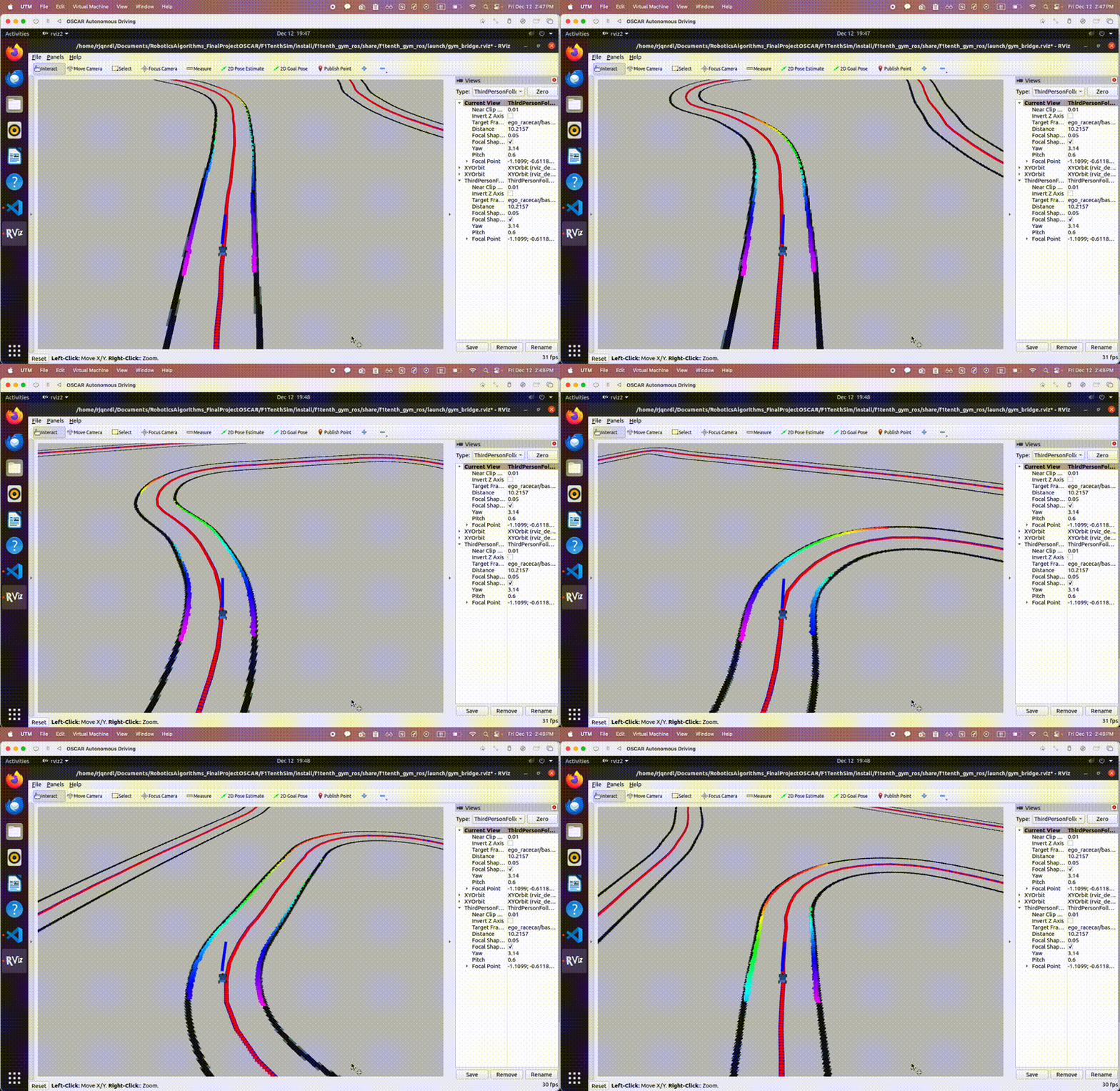
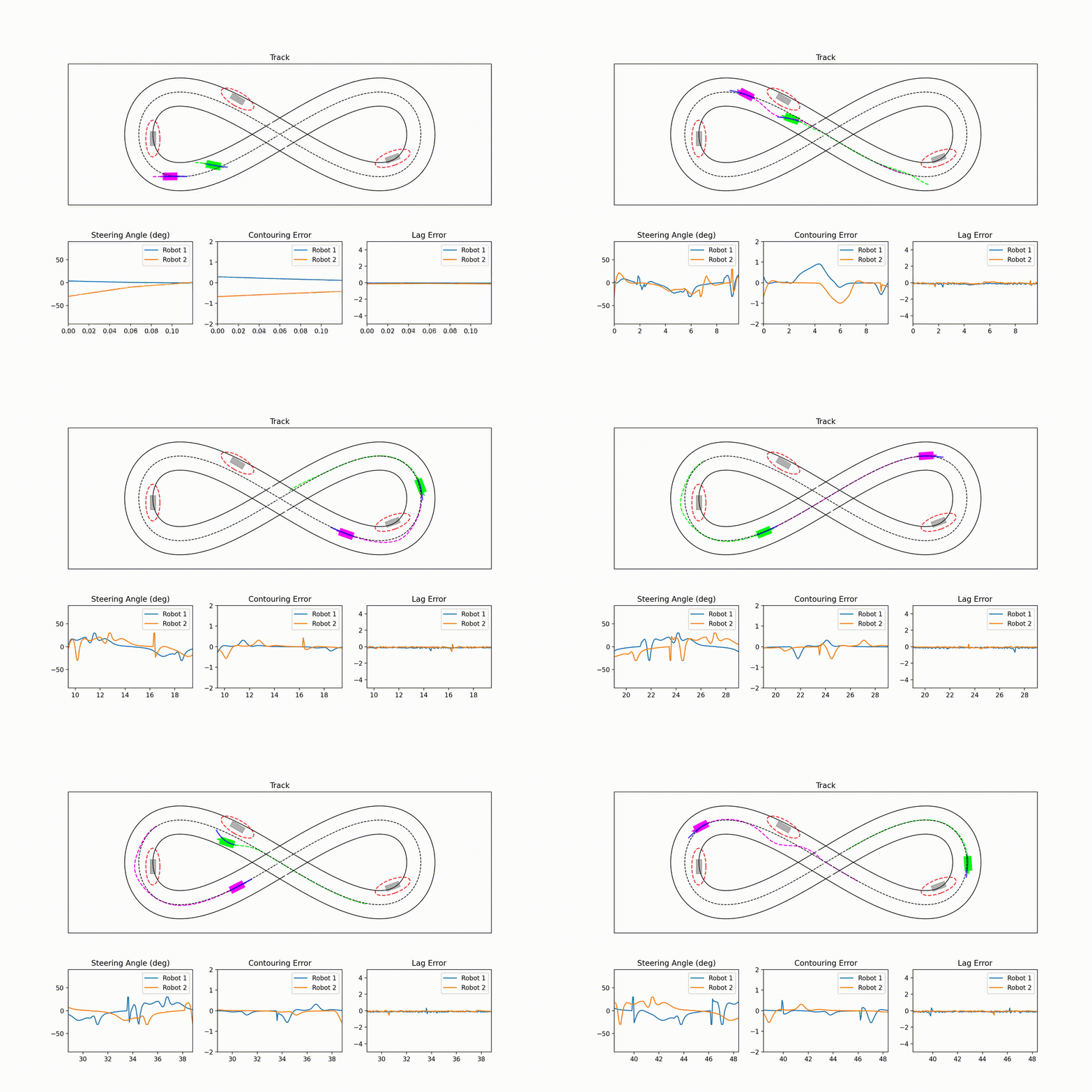
To validate the full stack safely, we developed both low and high-fidelity simulation environments based on the F1TENTH Gym ROS platform. The simulator was extended to support multi-vehicle interactions, obstacle modeling, and detailed logging for systematic evaluation of control behavior and safety-performance trade-offs.
We conducted extensive parameter tuning experiments, analyzing how prediction horizon length, cost weights, and avoidance penalties shape driving style: from conservative to aggressive. These experiments highlighted that controller tuning reflects value-based design choices (e.g., safety vs. competitiveness), rather than purely technical optimization.
Finally, the same ROS2-based control stack was deployed on a real F1TENTH vehicle, using a Vicon motion capture system for high-precision state estimation. The controller demonstrated stable track following and aggressive cornering behavior consistent with simulation results, confirming reliable simulation-to-real transfer on an embedded platform.
Explore More Works and Projects!
 JIYEONG OH