The Problem with Manual Gait Scoring
Gait deficits are a key feature of Down syndrome, and measuring them in mouse models is central to understanding the condition. The standard protocol involves filming mice walking from below, then manually going through video frame by frame – overlaying three consecutive footfalls in Photoshop, measuring distances and angles by hand.
It works, but it’s slow. And the results depend on which frames each scorer picks.
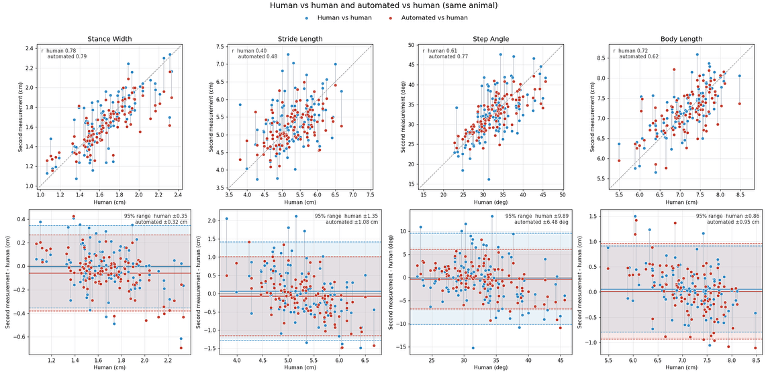
Can an automated pipeline produce measurements that agree with a human scorer as closely as two human scorers agree with each other?
We built an end-to-end pipeline on DeepLabCut using standard ventral-view videos – no specialized hardware required.
The model runs in two stages. A Faster R-CNN detector first finds the mouse in each frame and crops it out, removing background clutter like corridors and rulers. A ResNet-50 pose network then predicts six keypoints on the cropped region: four paws, head tip, and tail base.
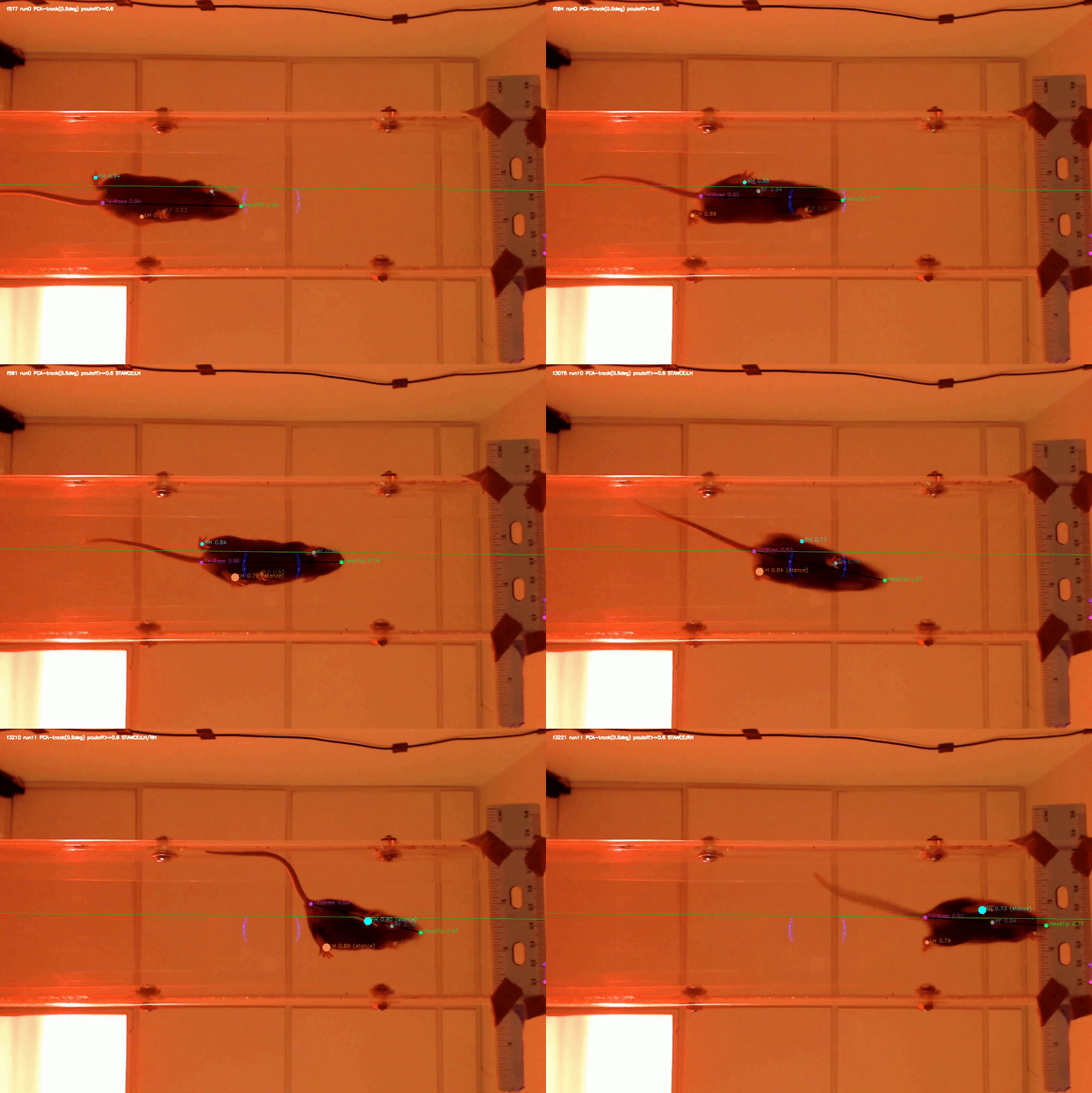
From keypoints to gait metrics, the pipeline filters out non-walking frames (turns, stops, backward motion), classifies each hind paw as stance or swing per frame, identifies footfalls, and computes the same four measures scorers use – stride length, stance width, step angle, and body length – in centimeters using the ruler visible in each video.
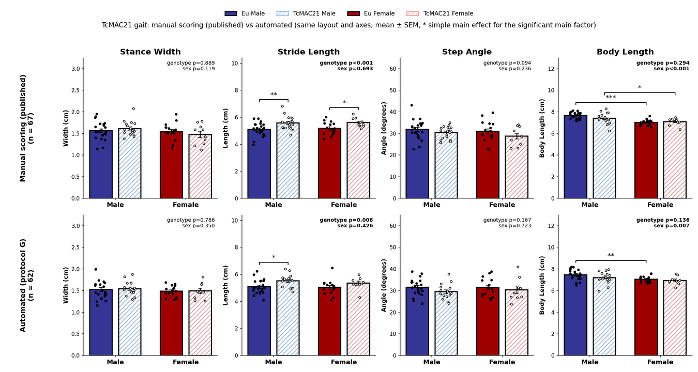
The pipeline was evaluated on 60 TcMAC21 mice scored independently by two human scorers. For each animal, we compared automated-vs-human agreement to human-vs-human agreement. The pipeline was also applied to Ts65Dn mice with Dyrk1a normalization, a cohort not yet fully scored by hand. Key findings include shorter body length and wider stance in Ts65Dn mice, and longer strides relative to body size – consistent with known phenotypes. The cohort is still small, so treatment effects remain preliminary.
Explore More Works and Projects!

