Robotic Companions That Learn to Care
Stability Under Noise: Feedback Control for Surgical Robotic Systems
Surgical robotics promises precision beyond human capability but that promise depends on one critical assumption: the robot moves where it is told to move. In practice, tremor, mechanical vibration, and sensor noise introduce deviations that accumulate over a procedure and translate directly into clinical risk.
This project examined a foundational question:
How much does feedback-driven control actually improve motion stability under irregular, unpredictable disturbances, and at what cost?
Injecting Realistic Disturbances
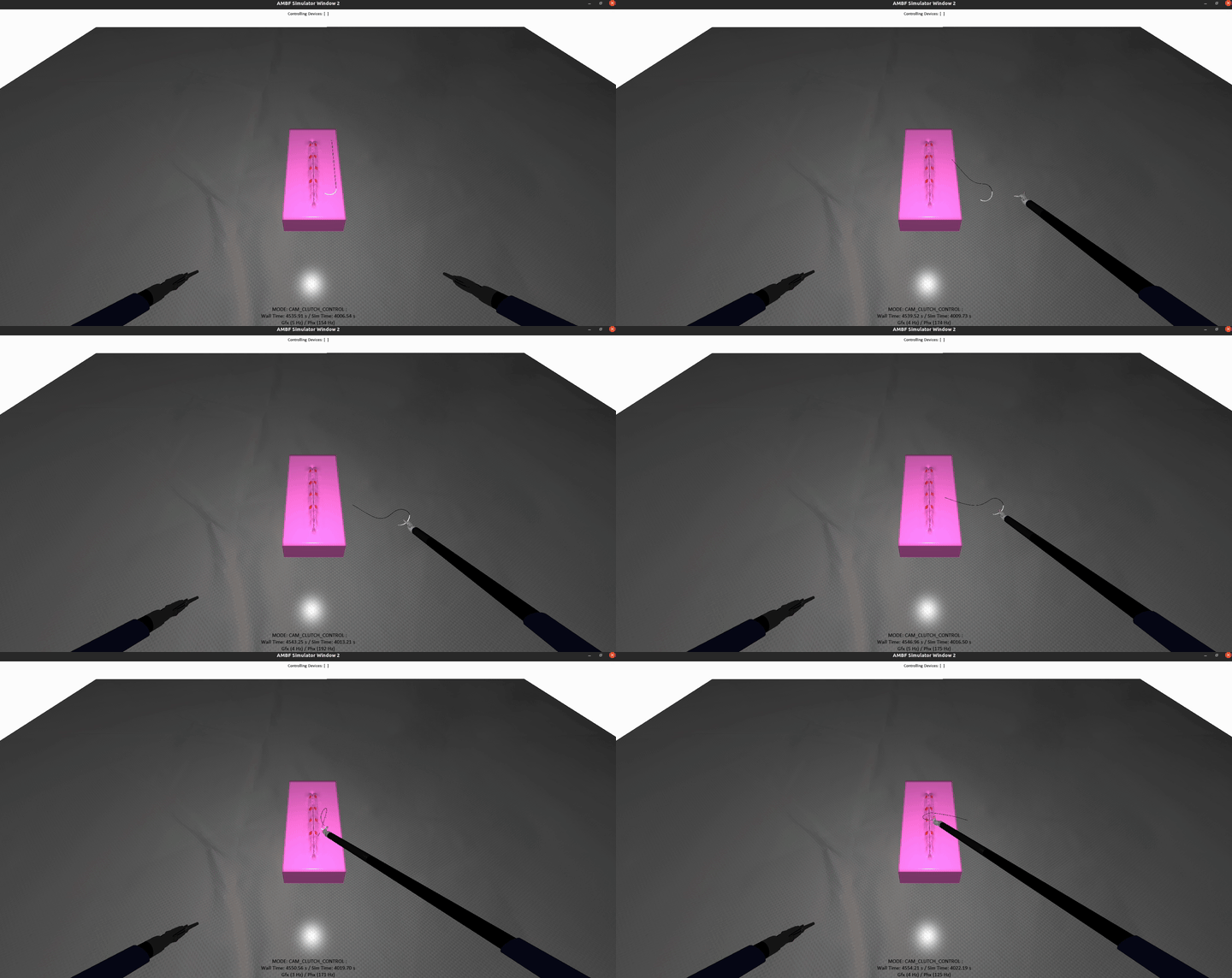
Using the AMBF-based Surgical Robotics Challenge environment with a dVRK PSM, we injected synthetic non-periodic tremor directly into the end-effector. Non-periodicity matters: real physiological tremor is irregular in both amplitude and frequency, and controllers that handle sinusoidal noise well often fail on realistic inputs.
A Cartesian-space PID controller was implemented to compensate for disturbances in real time, benchmarked against a noise-only baseline with no active feedback.
Rather than measuring binary task success, I evaluated three metrics across repeated trials: lateral deviation, trajectory progress, and command smoothness.
PID feedback produced consistent reductions in tracking error and improved trajectory completion. It also revealed a meaningful trade-off – tighter correction improved accuracy but reduced command smoothness under strong disturbances, framing controller tuning as a design choice between precision and stability.
Explore More Works and Projects!

